
So a Friend or Family Member Is Officiating Your Maine Wedding: A Coastline Weddings Guide for Couples and Their Officiants
There is something quietly beautiful about being married by someone who actually knows you. A college roommate. A favorite uncle. The friend who introduced you in the first place. When the person standing in front of you has a real story to tell, the ceremony stops feeling like a formality and starts feeling like the most meaningful part of the weekend.
It’s also one of the most common questions we get from couples: Can we really have our best friend marry us? How does that work in Maine? And what on earth do they actually say up there?
This guide is for you and for them. The first part is a short note for the couple — feel free to pass the rest along to your officiant. Everything after that is written directly to the person who’s writing your ceremony, with a clear walk-through of how to get ordained, how to structure the script, and how each element affects the timeline.
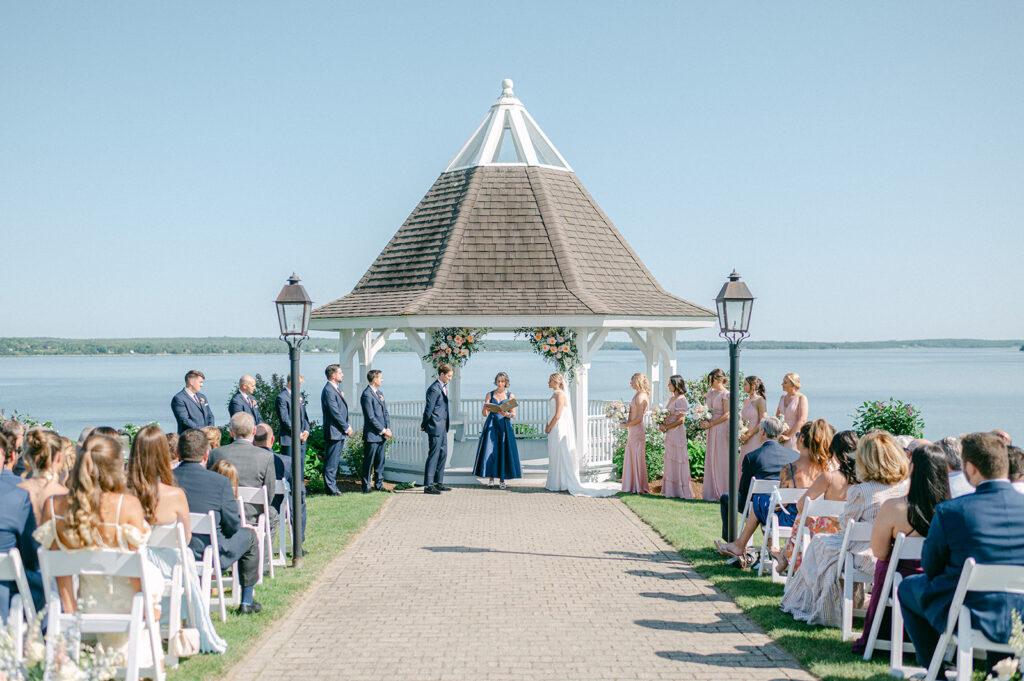
A Quick Note for the Couple
A few things that will make this easier on everyone:
Choose someone who is comfortable speaking in front of a group. The most meaningful officiants we’ve worked with aren’t necessarily the most polished speakers — they’re the ones who feel grounded enough to slow down, look up, and be present with you. Public speaking can be learned. Calm is harder to fake.
Give them time. A thoughtful ceremony takes most first-time officiants four to six weeks to draft, refine, and rehearse. We recommend asking them at least three months before the wedding and sharing this guide right away.
Be clear about tone. Some couples want their ceremony reverent and traditional. Others want it warm and a little funny. Some want a blend. Your officiant cannot read your mind — tell them what you’re imagining, and share examples of ceremonies you’ve loved attending.
Decide on vows early. Whether you write your own or use traditional vows changes the length of the ceremony by several minutes and shapes the emotional arc of the whole thing. More on that below.
We’ll handle the rest of the day around them; the processional timing, the music cues, the rehearsal walk-through, the signing of the license. Their job is to write something meaningful and deliver it with care. Ours is to make sure everything around that moment flows the way it should.
Now, the rest is for your officiant.
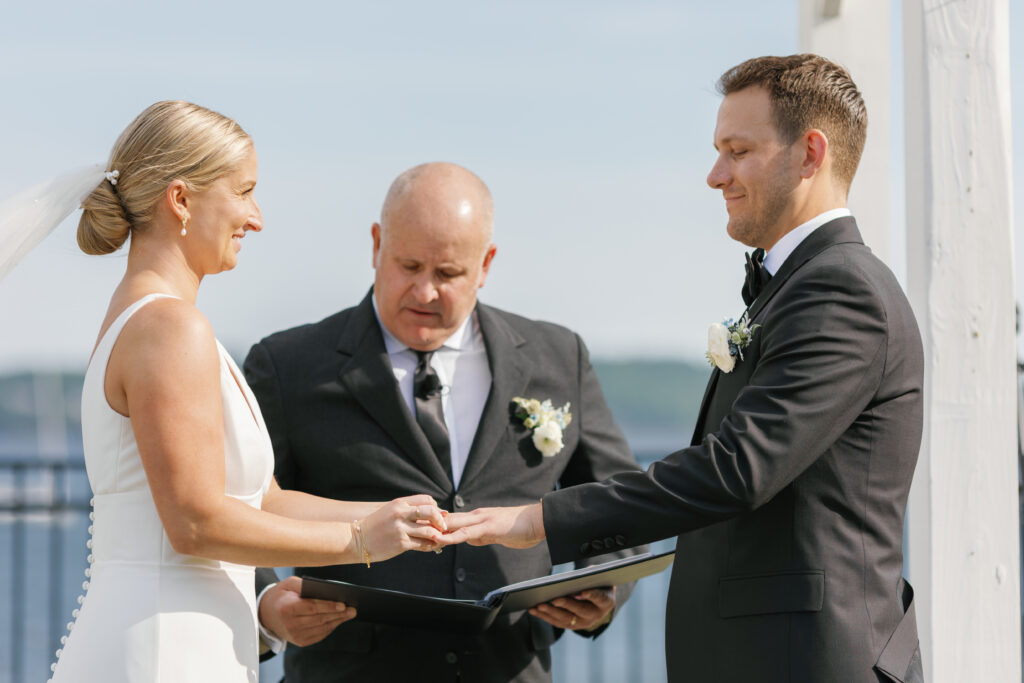
For the Officiant: Welcome
First, what an honor. The couple chose you because of who you are to them. That alone is the reason this will be meaningful, no matter how nervous you feel right now.
This guide will walk you through everything from getting ordained, to understanding how a ceremony is built, to writing the script, to managing the timing so the day flows the way the couple has planned in the order it makes sense to tackle it.
Let’s start with the legal piece, because it’s the simplest part.
Getting Ordained in Maine
Maine is one of the most welcoming states in the country for friend-and-family officiants. The state recognizes ordained ministers regardless of whether the ordination came through a traditional seminary or an online ministry, and there is no separate state registration to complete. You will not need to file paperwork with the Secretary of State, pay a fee to Maine, or carry a license number on the day. You simply need to be ordained before you sign the marriage certificate.
Here are the two organizations we most often recommend.
Universal Life Church (ULC)
The Universal Life Church is the most widely used online ordination in the United States. The process takes about five minutes, costs nothing, and you’ll have your credentials almost immediately. ULC ordinations are explicitly recognized in Maine and have been used for thousands of weddings in the state. Their site also offers an optional minister’s package with a printable ordination certificate and a wallet card — both of which are worth ordering for peace of mind, even though Maine does not require you to present them.
Visit: ulc.org
Church of Spiritual Humanism
If a non-religious framing feels more natural to you and the couple, the Church of Spiritual Humanism is a thoughtful alternative. It is a humanist church grounded in the principle that ceremony and meaning can exist outside of any particular faith tradition. Ordination is also free, online, and quick.
Visit: spiritualhumanism.org
A Few Practical Notes
Order a printed copy of your ordination credentials and bring them to the rehearsal. Maine does not require you to show them, but having a physical certificate in your bag makes a calm situation calmer.
If you have any unusual circumstances, for example, you live abroad, you are under 18, or the couple is being married in a town with its own additional clerk requirements, let your planner know early so we can confirm.
A few other things to keep in mind about Maine marriage law:
The 90-day window. A Maine marriage license is valid for 90 days from the date the couple picks it up at the town office. There is no waiting period, the couple can be married the same day the license is issued, as long as they’re within that 90-day window.
Two witnesses, both over 18. You will sign the marriage license alongside the couple and two witnesses. We’ll coordinate the signing location and timing so it happens naturally, usually right after the ceremony, before cocktails.
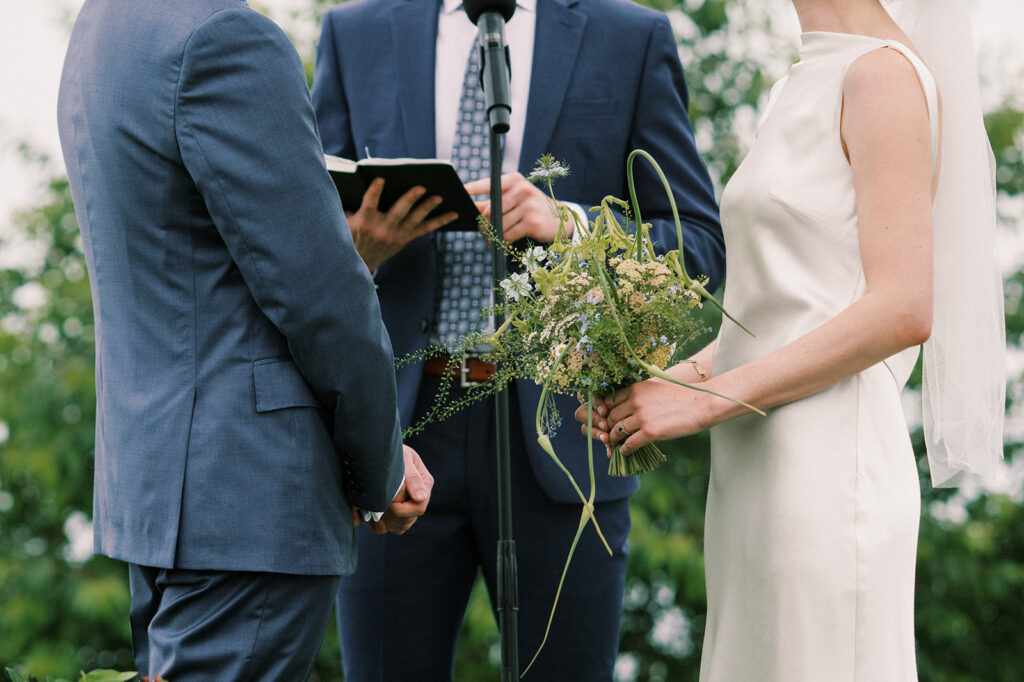
The Anatomy of a Wedding Ceremony
A wedding ceremony is essentially a story told in a specific order. Once you understand the structure, writing it becomes much less intimidating.
Here is the flow of a traditional ceremony, with notes on what each section is for and how long it typically runs. Total ceremony length usually lands between 20 and 30 minutes, depending on which elements you include.
1. The Processional* (3–7 minutes)
This is the entrance of the wedding party and the couple. You aren’t speaking yet, but you’ll be standing at the front, calmly, smiling at guests as they take their seats and the music plays. Your planner will cue the start.
Timing impact: This varies based on the size of the wedding party and the length of the aisle. A short aisle with no attendants might run two minutes. A long aisle with eight bridesmaids, eight groomsmen, grandparents, parents, and a flower girl can run closer to eight or nine. Confirm with the planner.
2. The Welcome* (2–4 minutes)
This is where you greet the guests and set the tone for what’s about to happen. A good welcome does three things: it thanks people for being there, it names the significance of the moment, and it introduces the couple in a way that feels warm and personal.
This is not the place for a long story or your big joke. Save those for the address. The welcome is the doorway.
A simple structure: “Welcome, family and friends. We’re gathered here today on the coast of Maine to celebrate the marriage of [Name] and [Name]. [One or two sentences about the meaning of the day.] [The couple] are so grateful to have you here — many of you have traveled from across the country to be present for this moment, and that is not lost on them.”
*The processional and welcome could be flip-flopped if the officiant is announcing an “Unplugged Ceremony” and requesting that guests silence their phones and refrain from taking photos during the ceremony.
3. Opening Remarks or Reflection on Love (2–4 minutes)
Some officiants include a brief reflection here, including things like what marriage means, on the nature of partnership, on the couple’s specific relationship. This can be a quote, a passage, or a few sentences in your own voice. It bridges the welcome into the more personal address that follows.
This section is optional. If you include it, keep it short.
4. Reading(s) (2–4 minutes each)
If the couple has chosen one or more readings, this is where they happen. A reader (or two, or three) will come up, deliver the reading, and return to their seat. You’ll introduce each reader by name.
Timing impact: Each reading typically adds 3–4 minutes when you account for the reader walking up, getting settled, reading, and returning. Two readings adds roughly 6–8 minutes to the ceremony. Three starts to feel long — we usually recommend capping at two unless one is very brief.
5. The Address (5–8 minutes)
This is the heart of the ceremony. It’s the part where you, the person who actually knows this couple, get to talk about them. Their story. What you’ve noticed about them together. Why they belong to each other.
The best addresses are specific. Not “they love each other deeply and complement one another well” but “the first time I saw them in the same room, I noticed how she went quiet when he started telling a story, and how he kept glancing over to make sure she was still laughing.” Concrete moments are what land.
A useful structure: how they met (briefly), what you’ve witnessed in their relationship (the heart of it), and what you hope for them going forward (a soft landing into the vows). Five to eight minutes is plenty. Anything longer starts to test guests’ attention, especially in warm sun or cool coastal wind.
6. Special Ritual or Unity Element (3–7 minutes, optional)
Some couples include a symbolic ritual: a handfasting, a unity candle, a sand ceremony, a wine box, a tree planting, or a ring warming. These are beautiful and add meaning, but each one adds time and choreography.
A few we see most often on the Maine coast:
Ring warming. The couple’s rings are passed through the guests during the ceremony so each person can hold them briefly and offer a silent wish or blessing. Lovely and meaningful, but it requires a designated start point (often during the readings or the address) and the rings must make it back to the front before the ring exchange. Plan for the rings to circulate for roughly 10–15 minutes; this happens during other parts of the ceremony rather than as its own block, so it doesn’t add length — but it adds coordination.
**Our suggestion- include this as part of the welcome. When you have a guest count of 125-150 guests, this can’t take some time and you don’t want to hold up the ceremony while waiting for the rings to make their way back to the front.
Handfasting. The couple’s hands are bound together with cords or ribbons. Adds about 3–5 minutes and is best paired with a brief explanation of the tradition.
Unity candle, sand, or wine box. Each adds 3–5 minutes and requires a small table at the front.
If the couple wants more than one ritual, we’d encourage choosing the one that resonates most. Layering several can dilute the meaning of each.
7. The Vow Exchange (3–10 minutes, depending)
This is the legal and emotional center of the ceremony. There are two main paths, and they have very different timing implications.
Traditional or repeated vows (3–4 minutes total). You read each vow line by line, and each partner repeats after you. “I, [Name], take you, [Name], to be my [husband/wife/partner]…” This is faster, more contained, and lets the focus stay on the moment rather than on the words themselves. Many couples find this option deeply moving in its own right — there’s something powerful about saying the same words generations have said before them.
Personal vows (6–10 minutes total). Each partner reads vows they’ve written themselves. These are usually 1.5 to 3 minutes per person, which means the vow exchange alone can run close to ten minutes once you add your brief introduction and the natural pauses for emotion. Personal vows are extraordinary when done well, but they require the couple to actually write them in advance (we recommend at least three weeks before the wedding) and to practice reading them aloud so they don’t lose composure.
A blend. Some couples do both — short personal vows followed by traditional repeated vows, or vice versa. This typically lands around 7–8 minutes.
The choice matters for more than timing alone. Personal vows shift the emotional weight of the ceremony to the couple themselves; traditional vows let the officiant carry more of the narrative. Talk with the couple early about which feels right for them, and let your planner know — the difference between a 22-minute ceremony and a 32-minute ceremony matters when we’re sequencing the rest of the day.
8. The Ring Exchange (2–3 minutes)
You guide the couple through placing the rings on each other’s fingers, usually with a short scripted line for each partner. “[Name], with this ring, I marry you, and bind my life to yours.” Brief, but a key visual moment for photography.
9. The Pronouncement (1 minute)
The legal moment. “By the power vested in me by the State of Maine, I now pronounce you married.” You’ll want to land this clearly and confidently — it’s the line everyone has been waiting for.
10. The First Kiss and Introduction (1 minute)
“You may now kiss.” Then, after a beat: “It is my joy to introduce, for the first time, [the newly married couple].”
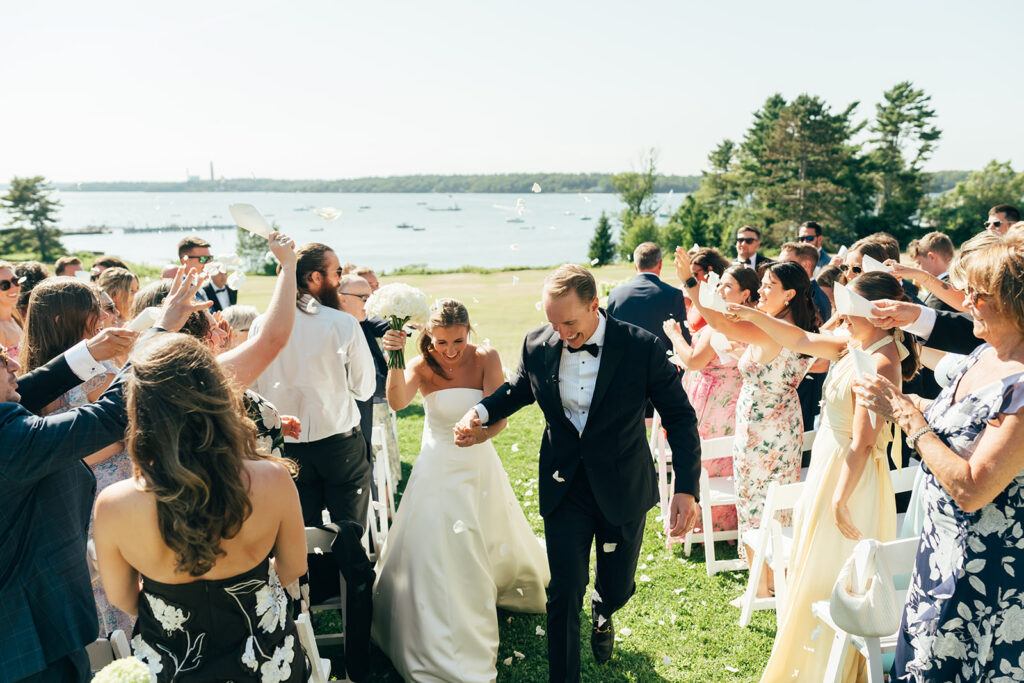
11. The Recessional (2–4 minutes)
The couple walks back down the aisle, followed by the wedding party. Music plays. You typically follow at the end, or step aside to let the planner cue everyone.
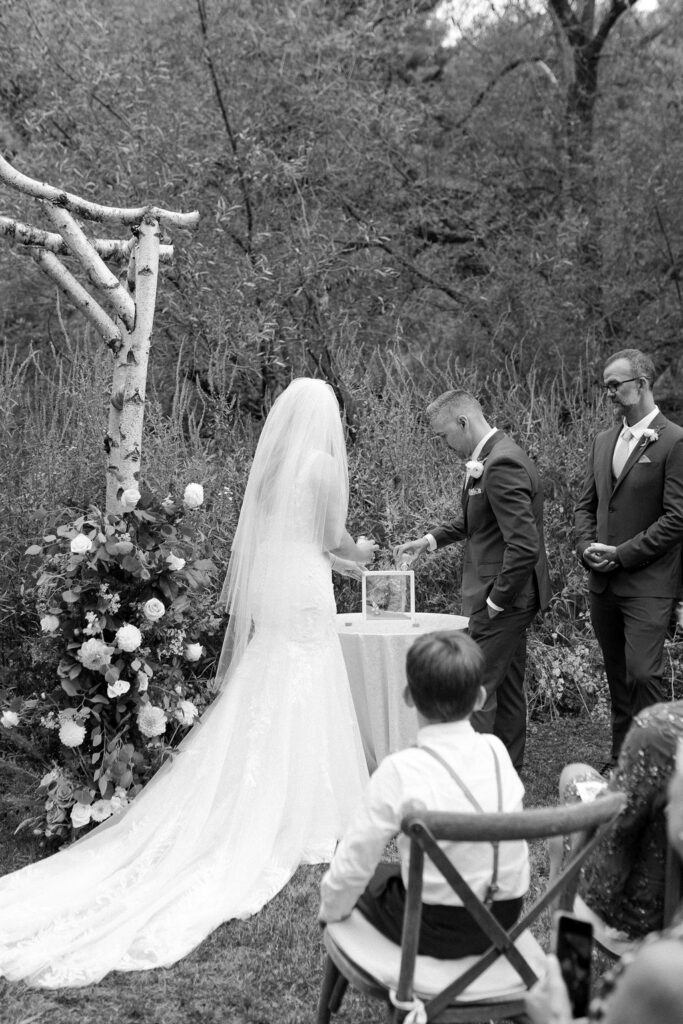
A Sample Timing Reference
Here’s how the elements add up in two common scenarios. Use this to estimate where your ceremony will land.
A relaxed coastal ceremony with personal vows, two readings, and a ring warming — roughly 32–35 minutes: Processional 5 min · Welcome 3 min · Reading 4 min · Address 6 min · Reading 4 min · Personal vows 8 min · Ring exchange 2 min · Pronouncement and kiss 2 min · Recessional 3 min.
A shorter ceremony with traditional vows and one reading — roughly 20–22 minutes: Processional 4 min · Welcome 3 min · Reading 3 min · Address 5 min · Traditional vows 3 min · Ring exchange 2 min · Pronouncement and kiss 1 min · Recessional 2 min.
Most ceremonies we plan land between 22 and 30 minutes. Anything longer than 35 begins to feel long for guests, especially outdoors. Anything shorter than 18 can feel rushed.
Tips for Writing the Script
A few things we’ve learned watching dozens of friend-and-family officiants do this beautifully.
Write it down word for word. Even if you’re a confident speaker, write the full script. Nerves change the way your brain works in the moment. Having the words in front of you is a gift to yourself.
Read it out loud as you write. Sentences that look fine on the page can be tongue-twisters when spoken. Reading aloud catches them.
Time yourself. Read the full script at the pace you’ll actually use — which is slower than your normal speaking and reading pace. Most people speak too quickly when nervous. Aim for a calm, conversational rhythm. Then add a minute or two for natural pauses, emotion, and laughter.
Pace it for outdoor sound. A Maine coastal ceremony often involves wind, distant boats, and an outdoor microphone. Slow down. Pause more than feels natural. Articulate the ends of words.
Print the final script in 14-point font, double-spaced, in a natural colored leather or linen folder. A loose sheet of paper looks unsteady in photos and is harder to read. The folder also gives you something grounded to hold.
Send the couple a draft two to three weeks out. They should read the address before the wedding day. You don’t want them surprised by a story they’d rather not have shared, and they may want to make small edits.
Practice at the rehearsal. The day before, walk through the full ceremony with the couple and the planner. This is when you’ll spot the moments that need a pause, the names that need confirming, and the cues that need coordinating with music.
The Week of the Wedding
A short checklist to keep in your bag:
A printed copy of your ordination credentials. A printed copy of the ceremony script in a folder. A BLACK pen for signing the license. Water (your mouth will get dry). The couple’s full legal names spelled exactly as they appear on the license. The names of any readers, ring-bearers, or others you’re introducing.
We’ll handle the marriage license itself, making sure it’s at the venue, that we have a quiet place for the signing, and that the witnesses know what they’re doing. Once it is signed, it is the officiants responsibility to mail or deliver back to the municipality.
A Last Word
You don’t have to be polished. You don’t have to be funny. You don’t have to be a poet. You only have to be present, prepared, and willing to let the couple be the focus.
The most meaningful ceremonies we’ve witnessed weren’t the most elaborate or the most clever. They were the ones where the officiant clearly loved the people in front of them, did the work to write something thoughtful, and held space for the moment to breathe.
If you have questions as you write, ask the couple. Ask their planner. We are here to help, this is one of our favorite parts of the weekend to be involved in, and we want you to feel calm, prepared, and at ease when you step up to the front.
Welcome to one of the best assignments of your life.
Coastline Weddings is a full-service planning and design studio based on the coast of Maine, helping couples gather for thoughtful, weekend-long celebrations along the New England shore. If you have a friend or family member officiating your wedding with us, share this guide with them as soon as you can — it gives them the runway they need to do this well.
